
How to Build a Gravel Driveway That Lasts on Tennessee Clay Soil (Step-by-Step Guide)
If you live in Sequatchie County, Dunlap, Jasper, or the surrounding communities along the Cumberland Plateau, you are likely all too familiar with the trials of Tennessee clay soil. When heavy spring rains hit our region, traditional gravel driveways often seem to vanish overnight. Rock sinks into the mud, deep ruts form after a single delivery truck passes, and standing water turns your approach into an impassable swamp. At Whitzell Excavation, our team knows that a reliable driveway is not just about dumping stone on dirt: it is an engineering project rooted in local geology.
When you want an approach that withstands heavy seasonal rainfall and years of daily wear, partnering with experienced driveway excavation contractors makes all the difference. In this comprehensive guide, we walk you through our proven, phase-based approach to building a gravel driveway on stubborn Tennessee clay soil that will stand the test of time.
Phase One: Site Evaluation and Layout Planning
Solid. Precise. Planned.
Before a single bucket of dirt is moved, your driveway project requires careful planning and layout precision. Soil conditions across Dunlap and Sequatchie County vary significantly, but heavy, moisture-retentive clay is a constant challenge. Our team evaluates your property's topography, natural water flow, and load requirements to design an approach tailored to your land.
► Route optimization ensures your driveway avoids natural depressions and low-lying wet zones where water naturally pools.
► Utility location guarantees that public and private lines are safely marked before any excavation equipment touches your soil.
► Width specifications are established early, typically planning for a standard 10-to-12-foot residential width with wider turnarounds if necessary.
When you invest in professional planning, you eliminate costly guesswork and ensure your driveway aligns perfectly with your property layout and future milestones.
Phase Two: Stripping Topsoil and Subgrade Preparation
Deep. Clean. Excavated.
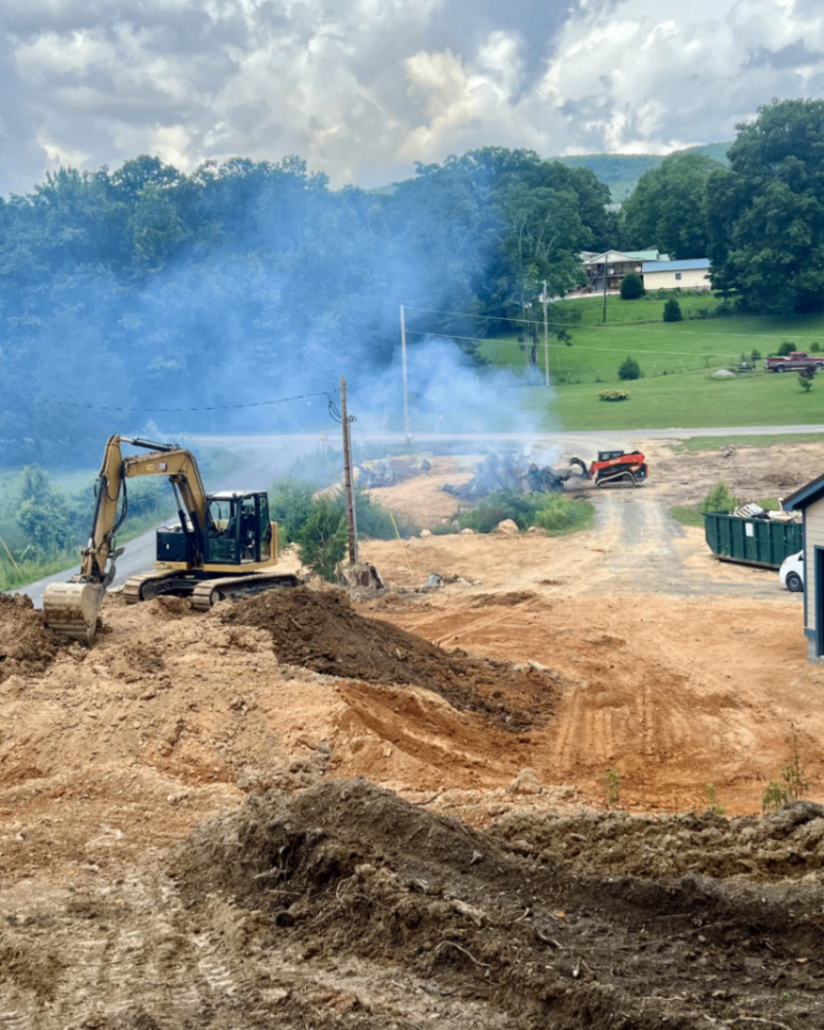
The primary reason DIY gravel driveways fail in Tennessee is improper subgrade preparation. Topsoil and organic matter are spongy and retain moisture; if you dump gravel directly onto unstripped topsoil, the entire structure will shift and sink.

Our team uses heavy machinery to strip away topsoil, roots, and organic debris down to firm, stable mineral clay. For more insights on why professional earthwork is essential, explore our guide on professional residential excavation contractors.
► Topsoil removal strips away soft organic material that prevents proper structural compaction.
► Subgrade grading establishes a solid clay foundation shaped with a distinct crown to shed water.
► Mechanical compaction uses heavy rollers or plate compactors to press the clay subgrade to maximum density, eliminating air pockets.
By establishing a rigid, compacted clay subgrade, we create a secure foundation that prevents your driveway from sinking under heavy vehicle loads.
Phase Three: Installing Geotextile Fabric and Base Aggregate
Layered. Stable. Reinforced.
Clay soil has a frustrating habit of "pumping": pushing upward into gravel layers when wet while the gravel sinks downward under weight. To stop this migration, professional excavation requires a high-strength separation layer.

Once your subgrade is compacted, we install industrial-grade geotextile fabric across the entire footprint before laying any stone. Learn more about our comprehensive site prep techniques on our site prep services page.
► Geotextile separation prevents clay and stone from mixing, preserving the structural integrity of your base.
► Crusher run foundation provides 4 to 6 inches of dense-graded crushed stone and stone dust that locks tightly together when compacted.
► Multi-lift compaction ensures each layer of base stone is thoroughly compressed in stages for maximum load-bearing strength.
This robust foundation layer distributes the weight of cars, delivery trucks, and farm equipment evenly across the clay, ensuring permanent structural stability.
Phase Four: Drainage Solutions and Surface Grading
Sloped. Protected. Draining.
Water is the ultimate enemy of any gravel driveway, especially on impermeable Tennessee clay. Without dedicated drainage features, even the best-built base will eventually wash out or saturate.

Our team integrates precise drainage engineering into every driveway project we undertake. For further reading on managing water runoff and site grading, check out our expert advice on proper grading and drainage solutions.
► Crown shaping ensures the center of your driveway sits higher than the edges, forcing rainwater to shed sideways immediately.
► Side ditches and swales capture runoff from the crown and guide it safely away from your driveway bed.
► Culvert installation prevents erosion by managing cross-flows where driveways intersect natural drainage paths or creeks.
With professional drainage in place, you gain total peace of mind knowing your investment is safeguarded against heavy seasonal downpours.
Phase Five: The Wearing Course and Final Polish
Angular. Durable. Finished.
The final step in building a lasting gravel driveway is installing the top wearing course. Unlike rounded river rock: which acts like ball bearings and rolls away under tires: we use angular crushed stone that interlocks securely.
► Crushed angular stone (typically ¾-inch to 1-inch aggregate) provides superior tire traction and resists displacement.
► Even distribution spreads the wearing course smoothly across the compacted crusher run base at a depth of 2 to 3 inches.
► Light rolling settles the surface stones just enough to lock them in place while preserving a natural, durable texture.
Your new driveway is now ready to handle daily traffic with elegance, durability, and minimal maintenance. Browse our latest updates and projects over on our Whitzell Excavation blog.
Why Partner with Whitzell Excavation?
Experienced. Local. Trusted.
Building a gravel driveway that actually lasts on Tennessee clay requires specialized equipment, regional geological knowledge, and precise technical execution. Doing it yourself or hiring inexperienced operators often leads to repeating the exact same expensive mistakes every few years.
When you work with our licensed and insured team at Whitzell Excavation, you are partnering with local experts who understand the unique soil mechanics of Sequatchie County and the surrounding Cumberland Plateau. We take pride in delivering on-time project completion, transparent communication, and exceptional craftsmanship for every homeowner and builder.
Contact our team today to schedule your consultation and build a rock-solid foundation for your property's success.

