
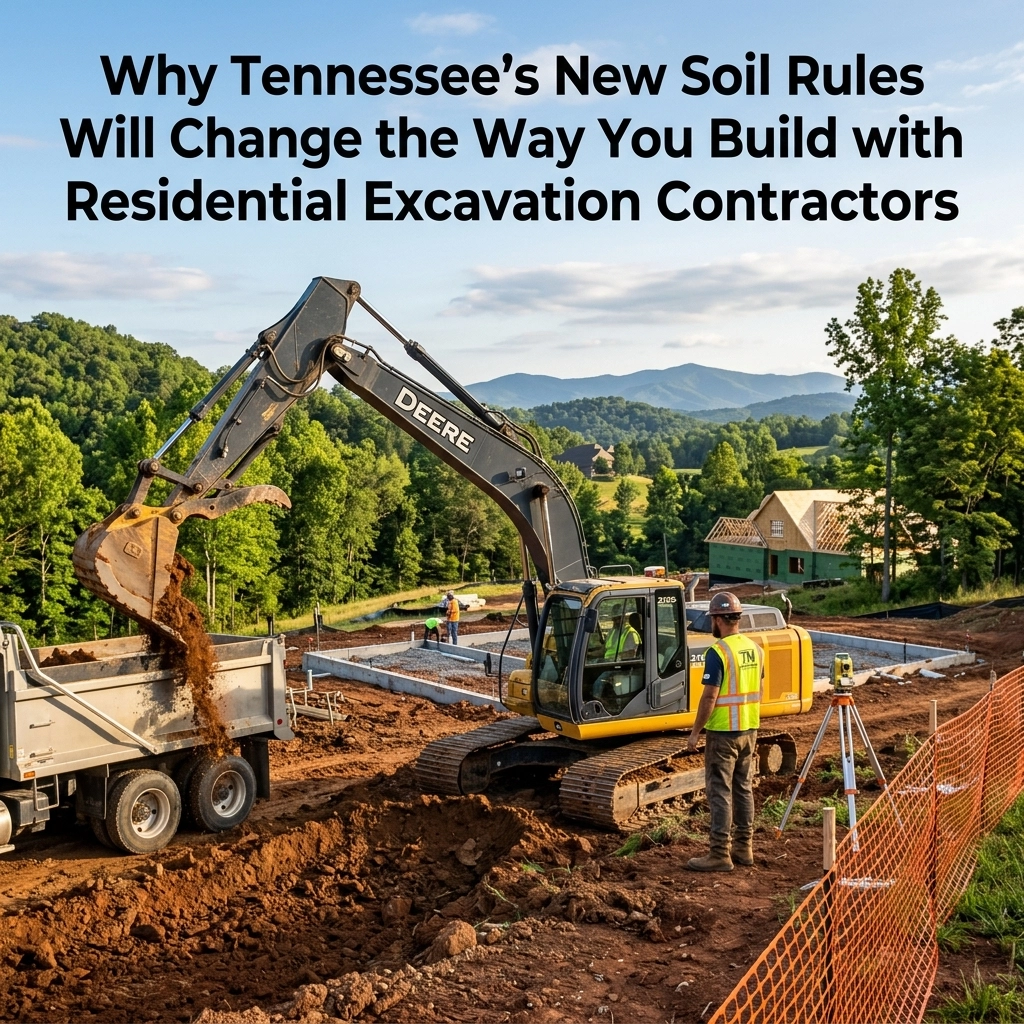
Why Tennessee’s New Soil Rules Will Change the Way You Build with Residential Excavation Contractors
Building a home in Tennessee has always required a deep understanding of the land. Whether you are breaking ground in the rocky terrain of Jasper or the rolling hills of Spencer, the dirt beneath your feet dictates the success of your structure. Recently, the landscape of residential construction changed significantly with the implementation of new soil regulations that took effect in February 2026.
These rules, established by the Tennessee Department of Environment and Conservation (TDEC), have fundamentally altered how we manage soil during the excavation phase. For homeowners and contractors alike, these updates are not just bureaucratic hurdles; they represent a major shift in how we approach site preparation and land management. At Whitzell Excavation, we have adapted our processes to ensure every project remains compliant while maximizing the cost-saving opportunities these new rules provide.
Understanding these changes is essential for anyone looking to build a stable, long-lasting home in our region. From Dunlap to Pikeville, the way we handle "dirt" at Whitzell Excavation is no longer just about moving it from point A to point B. It is about professional categorization, environmental responsibility, and structural integrity.
Understanding the February 2026 Soil Regulation Update
For decades, excess soil from construction sites was often treated as waste. If there was even a hint of contamination or if the soil didn't meet specific aesthetic standards, it was hauled off to a landfill. This process was expensive, time-consuming, and environmentally taxing. The new rules introduced a more logical, streamlined approach to soil management.
These regulations focus on the "reuse" of soil. Instead of automatically labeling excavated material as solid waste, the state now provides clear pathways for testing and relocating soil to other sites. This shift is designed to encourage sustainability while lowering the overall cost of large-scale residential projects. For our team at Whitzell Excavation, this means more time spent on precision planning and less time dealing with landfill logistics.

The Shift from Disposal to Management
Compliant. Efficient. Resourceful.
The primary goal of the new rules is to create clarity. Before these updates, many developers in the Sequatchie Valley faced uncertainty regarding whether their excavated soil could be used as fill elsewhere. This uncertainty often led to "playing it safe" by paying high fees to dispose of perfectly usable material.
Now, the state has provided a framework that treats soil as a valuable resource. At Whitzell Excavation, we work closely with our clients to evaluate the soil on-site early in the process. By determining the soil's quality and history through professional environmental assessments, we can often keep material on-site or move it to a secondary location where it is needed for grading or slope correction.
Category 1 vs. Category 2 Soil
Precise Categorization. Reduced Waste.
The new regulations divide soil into two distinct categories based on its composition and history. Understanding which category your soil falls into is the first step in any modern excavation project.
► Category 1 Soil consists of material where contamination levels are below established background levels. This soil is essentially "clean" and can be moved off-site to almost any other location without extensive TDEC oversight. This is a game-changer for site preparation in Pikeville and Whitwell, as it allows us to share resources between local builds.
► Category 2 Soil refers to material that may have some levels of contamination but is still safe for specific types of reuse. This soil can often be moved to other construction sites, public road projects, or industrial areas, provided it is managed under a TDEC-approved plan. We handle the logistics of these approvals so that your project stays on schedule.
How These Rules Impact Your Construction Costs
One of the most common questions we hear from homeowners in Marion County and Grundy County is how these rules affect the bottom line. While new regulations often sound like they will add cost, these specific updates are designed to do the opposite for those who work with expert contractors.
By reducing the reliance on landfills, Whitzell Excavation can significantly lower the overhead of a residential build. Excavation is the foundation of your entire investment, and managing the soil correctly is the most effective way to protect that investment.
Reducing Landfill Fees and Hauling Costs
Cost-Effective. Localized. Smart.
In the past, hauling "waste" soil to a landfill was a major expense. You weren't just paying for the fuel and the labor; you were paying the landfill's tipping fees, which have risen steadily over the years. Under the new rules, if your soil qualifies for reuse, those fees disappear.
► Localized soil relocation allows us to keep materials within the community. Instead of driving miles to a waste facility, we can often find a nearby project in Spencer or Tracy City that needs fill dirt for proper grading.
► Purchasing fill material becomes less frequent when we can effectively reuse what is already on your land. By balancing the "cut and fill" on a property, we minimize the need to bring in outside dirt, which ensures the soil's consistency and saves you money.

Speeding Up the Site Prep Timeline
Streamlined. Faster. Professional.
Time is money in construction. The new rules provide a faster track for soil evaluation through the Voluntary Cleanup Oversight and Assistance Program (VOAP). By enrolling projects in this program, we get quicker answers from the state regarding soil safety and relocation.
We understand that you want to move from foundation digging to framing as quickly as possible. Our expertise at Whitzell Excavation in navigating these new regulatory pathways means fewer delays at the start of your build. We ensure that all sampling and documentation are handled correctly the first time, preventing the "stop-work" orders that often plague less experienced teams.
Why You Need an Expert Team for Compliance
Navigating Tennessee's new soil rules isn't something a homeowner should do alone. It requires a deep understanding of environmental standards, soil science, and local geology. As residential excavation contractors at Whitzell Excavation, our role has expanded from just operating heavy machinery to serving as consultants on land health and regulatory compliance.
Whether you are working on a septic prep project in Dunlap or a complex residential development in Jasper, the stakes are higher than ever.
Navigating the VOAP and TDEC Standards
Expert Oversight. Legal Assurance.
The Voluntary Cleanup Oversight and Assistance Program (VOAP) is now a central part of the excavation process for many Tennessee builds. This program allows for a streamlined review of soil management plans. However, the application process is technical, which is why Whitzell Excavation approaches it with a detail-oriented process.
► Documenting site history is now a standard part of our pre-excavation checklist. We look at previous land use in areas like South Pittsburg and Powells Crossroads to anticipate any potential soil issues before we even start the engines.
► Developing soil-use plans is a requirement for moving Category 2 soils. We create these plans with precision, detailing exactly where the soil is going, how it will be covered, and how it will be compacted to ensure long-term stability.

Professional Soil Sampling and Analysis
Technical Precision. Guaranteed Results.
You cannot manage what you haven't measured. The new rules rely heavily on "professional judgment" and actual site data. At Whitzell Excavation, we utilize modern sampling techniques to get a clear picture of what is in your dirt. This data is vital for ensuring the longevity of your build.
► Testing for compaction ensures that reused soil provides a stable base for your foundation. Soil that isn't properly analyzed can lead to settling issues, cracks in your slab, or poor drainage later on.
► Identifying drainage risks is a key part of our soil analysis. In Tennessee, managing water is just as important as managing dirt. Our team uses this soil data to prevent common yard drainage mistakes before they happen.
Building for the Future in the Sequatchie Valley
Our service area, including Bledsoe, Grundy, and Marion Counties, features some of the most beautiful but challenging terrain in the state. From the heights of Monteagle to the valley floors of Whitwell and Dunlap, every site requires a unique approach. These new soil rules give Whitzell Excavation better tools to build houses that last while respecting the local environment.
Tailored Excavation for Local Landscapes
Rugged. Reliable. Regionally Focused.
We don't believe in a one-size-fits-all approach to excavation. The soil in Lusk or Hendon is different from the soil in Middle Valley. Our local experience at Whitzell Excavation allows us to apply these new state rules in a way that makes sense for our specific geography.
► Slope correction and grading are often the biggest challenges in our region. By utilizing the new soil reuse rules, we can more effectively move earth to create flat, buildable pads on hilly terrain without the massive cost of hauling in external fill.
► Site preparation for rural builds often involves navigating complex health department standards for septic systems. We ensure that our soil management plans align with all local and state requirements, providing a seamless experience for the homeowner.
Your Trusted Expert in Modern Excavation
At Whitzell Excavation, we pride ourselves on being more than just guys with backhoes. We are professionals who stay ahead of the curve so that our clients don't have to. The transition to Tennessee’s 2026 soil rules has been a major change for the industry, but we have embraced it as an opportunity to provide better service and more value.
Our team at Whitzell Excavation possesses the technical expertise, heavy equipment, and regulatory knowledge to handle any residential project, regardless of size or complexity. We understand that the foundation of your home starts long before the concrete is poured: it starts with the very first scoop of dirt. By following the new state guidelines, we ensure that your project is built on a foundation of compliance, safety, and structural integrity.
Whether you are a homeowner planning your dream house or a fellow contractor looking for a reliable partner in Sequatchie County, Whitzell Excavation is here to help. We focus on the longevity of our work, ensuring that every site we prepare is built to stand the test of time. In an era of changing regulations, you need a partner who knows the ground as well as the rules. We are that partner.

