Pond Digging Services in Tennessee: Building a Pond That Actually Holds Water Year-Round
A farm pond or stocked pond can add practical value, recreation, livestock water, irrigation, and long-term appeal to your Tennessee property. However, successful pond construction involves much more than digging a hole and waiting for rain.
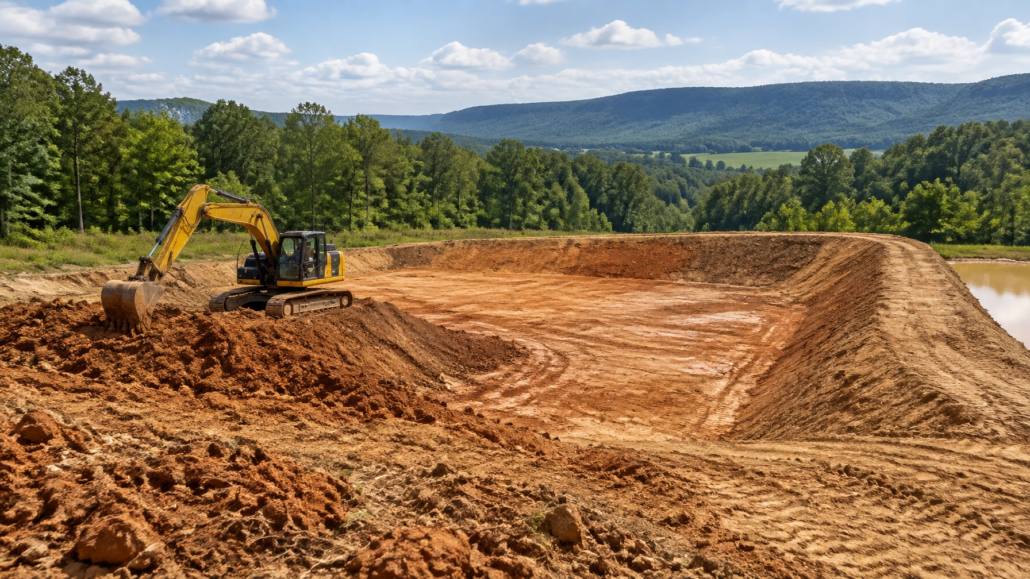
Our team designs pond excavation around soil conditions, watershed behavior, slope, depth, compaction, water control, and long-term maintenance. For landowners in Dunlap, Jasper, Spencer, Altamont, Tracy City, and surrounding communities, the right pond digging services can determine whether your pond holds water year-round or becomes an expensive, muddy depression.
Phase One: Evaluate the Site Before Digging
Measured. Local. Strategic.
The best pond location may not be the lowest point on your property. Before excavation begins, our team evaluates how the land collects, stores, and releases water.

Soil Composition and Seepage Risk
Tennessee soils vary significantly across the Cumberland Plateau and surrounding areas. Some sites contain enough natural clay to form a dependable basin. Others include sand, gravel, fractured rock, or thin soil over limestone.
We look for:
► Clay content: Plastic clay can help form a low-permeability pond bottom when properly placed and compacted.
► Sand and gravel layers: These materials allow water to escape quickly unless we install an engineered sealing system.
► Rock and limestone: Karst features, fractures, and solution cavities can create hidden seepage paths in parts of Middle and East Tennessee.
► Borrow material: We identify whether suitable clay exists elsewhere on the property or must be hauled in.
A professional soil investigation may include test pits, borings, and examination of the proposed dam, basin, spillway, and borrow areas. The NRCS Agricultural Handbook 590 provides detailed technical guidance for farm pond planning.
Watershed and Water Supply
A pond needs a reliable water source, but too much runoff can damage the dam and spillway. Our team evaluates the contributing watershed, the land area that drains toward the pond, and considers:
► Rainfall patterns: Tennessee storms can deliver intense runoff in a short period.
► Upstream acreage: The watershed must provide enough inflow without overwhelming the pond.
► Existing channels: Small draws, wet-weather conveyances, and intermittent streams may affect the design and permitting process.
► Sediment movement: Bare slopes and eroding fields can fill a pond with silt long before the structure reaches its expected service life.
A pond sized only by appearance may not perform well. We size the basin, outlet, and emergency spillway around the property’s actual drainage behavior.
Water Table and Slope
A high water table may help maintain pond levels, but groundwater conditions can also complicate excavation, construction access, and bank stability. A low water table does not automatically prevent pond construction, but it places greater importance on watershed inflow and sealing.
Moderate slopes often provide a practical location for an embankment pond. Extremely steep ground increases excavation, stabilization, and access costs. We also examine how the pond will affect neighboring properties, roads, septic systems, structures, and natural drainage paths.
Our professional excavating services help you understand site conditions before your investment reaches the digging stage.
Why Tennessee Clay Does Not Guarantee a Full Pond
Natural. Variable. Technical.
Many Tennessee properties contain clay, but not every clay soil seals a pond. Clay particles expand when wet and can reduce water movement through the soil. However, clay can also shrink during extended dry weather, become difficult to compact when saturated, or behave unpredictably when it contains sand, gravel, or organic material.
That is why our team does not treat “red dirt” as an automatic pond liner.
We evaluate whether the soil has the right texture, moisture, and structure for compaction. We also look for dispersive or expansive clay conditions that can create erosion or cracking concerns. Proper moisture control matters: soil that is too dry will not compact effectively, while soil that is too wet can deform under equipment.
A reliable pond requires tested material, controlled placement, and consistent compaction, not simply a large amount of dirt.
Phase Two: Size and Shape the Pond for Its Purpose
Functional. Safe. Durable.
A livestock pond, irrigation pond, fishing pond, and recreational pond do not require the same layout. Before excavation, define how you intend to use the water.
Depth, Banks, and Fish Habitat
Stocked ponds generally need enough depth to maintain usable water during hot, dry periods. Many recreational and fishing ponds include a deeper central area, often in the range of 8 to 12 feet, but the appropriate depth depends on the watershed, fish species, evaporation, safety requirements, and site conditions.
We can plan:
► Deep-water zones: These provide refuge during summer heat and seasonal drawdown.
► Shallow shelves: Shelves support habitat and simplify selected vegetation zones.
► Stable side slopes: Slopes around 3:1 or flatter may improve safety and maintenance access where the site allows.
► Cleanout areas: A strategically shaped low point can make future sediment removal more manageable.
The finished shape should support your intended use while allowing safe equipment access and long-term maintenance.
Phase Three: Build the Core Trench and Compact the Earthwork
Keyed. Controlled. Watertight.
The core trench, also called a cutoff trench or keyway, helps prevent water from traveling beneath an earthen dam. Our team excavates the trench into suitable low-permeability material, then backfills it with approved soil in controlled layers.

Compaction means mechanically pressing soil particles together to reduce voids. In pond construction, that process directly affects seepage control and structural integrity.
We focus on:
► Suitable material: We separate organic topsoil, roots, debris, and unsuitable fill from structural soil.
► Thin lifts: We place clay and embankment soil in controlled layers rather than one thick mass.
► Moisture conditioning: We adjust soil moisture so the material compacts instead of cracking, pumping, or sloughing.
► Proper equipment: Sheepsfoot rollers and heavy compaction equipment help achieve a dense, cohesive embankment.
► Dam continuity: We tie the core, embankment, basin, and spillway together so water follows the intended path.
This phase separates professional pond excavation from ordinary dirt moving. Careful compaction protects your investment from seepage, piping, settlement, and premature repairs.
Phase Four: Choose the Right Sealing Method
Matched. Engineered. Long-Lasting.
If native soils do not provide adequate water retention, we evaluate additional sealing options.
Compacted Clay Liner
A clay liner uses selected low-permeability soil placed and compacted across the pond bottom and, where needed, the sides. This option works well when suitable clay is available and the subgrade can support a properly constructed liner.
Bentonite Amendment
Bentonite can improve water retention in selected soils when a qualified design specifies the correct application rate, mixing method, and compaction process. Applying bentonite without understanding the subgrade can waste money and leave seepage problems unresolved.
Synthetic Liner
A synthetic liner may suit smaller, specialized, or highly visible ponds where native soil conditions are poor. The liner requires careful subgrade preparation, protection from rocks and roots, secure edge detailing, and appropriate cover.
The right solution depends on soil testing, pond size, intended use, and budget. Our team helps you avoid paying for a sealing method that does not match your property.
Common Reasons New Ponds Fail
Preventable. Expensive. Avoidable.
Most pond failures begin before the excavator arrives.
► Poor site selection: The watershed cannot maintain the desired level, or runoff enters too aggressively.
► Uninvestigated soil: Sand, gravel, fractured rock, or unsuitable fill allows seepage.
► Weak core trench: Water travels under or through the dam.
► Improper compaction: Thick lifts, incorrect moisture, or inadequate equipment leave pathways for water.
► Undersized spillway: Heavy rainfall overtops the dam and causes erosion.
► Unstable banks: Steep or unprotected slopes slump into the pond.
► Unmanaged sediment: Erosion upstream gradually reduces depth and storage.
Our work addresses the pond as a complete water-retention system. That differs from a drainage or grading project, which primarily moves runoff away from a home, roadway, or building site. You can review our separate drainage solutions for water-conveyance work.
Permitting and Environmental Considerations
Compliant. Responsible. Documented.
Before construction, confirm whether the pond will affect a stream, wetland, lake, floodplain, or intermittent channel. Tennessee may require an Aquatic Resource Alteration Permit through TDEC when construction alters waters of the state.
Larger dams may also involve Tennessee’s Safe Dams Program. Earthwork that disturbs one acre or more may trigger construction stormwater requirements and erosion-control obligations.
We recommend contacting the local NRCS office or Soil Conservation District early, especially for farm ponds. Regulatory requirements vary by location and project design, so verify current requirements before excavation begins.
What Drives Pond Construction Cost?
Transparent. Practical. Specific.
Pond pricing depends on more than acreage. Key cost factors include:
► Excavation volume: Larger or deeper ponds require more machine time and material handling.
► Hauling distance: Imported clay, exported spoil, gravel, or rock can significantly affect the budget.
► Soil conditions: Rock, sand, groundwater, and unsuitable fill may require additional preparation.
► Sealing method: Clay liners, bentonite amendments, and synthetic liners have different material and installation costs.
► Dam and spillway design: Larger watersheds require more substantial water-control features.
► Access and clearing: Steep terrain, wooded access, and limited equipment routes increase labor and logistics.
A detailed site assessment gives you a more useful estimate than a price based only on pond dimensions.
Maintenance Keeps the Pond Working
Inspected. Protected. Ready.
After construction, inspect the dam, spillway, outlet, and banks at least annually and after major storms.
► Control woody growth: Large roots can create seepage paths through the dam.
► Repair erosion early: Small gullies become major failures when ignored.
► Keep livestock controlled: Hooves can damage banks and compact soil unevenly.
► Watch the water level: Persistent unexplained declines may indicate seepage.
► Manage sediment: Upstream erosion control and periodic cleanout protect capacity.

Plan Your Tennessee Pond With Confidence
Precise. Local. Dependable.
Whether you need a farm pond near Dunlap, a stocked pond outside Jasper, or a larger earthwork project in Spencer, Altamont, or Tracy City, our team provides the excavation knowledge and equipment needed to build with confidence.
Whitzell Excavation serves homeowners, landowners, contractors, and businesses with dependable excavation services in Dunlap, TN and surrounding communities. As experienced earthwork contractors and site preparation contractors, we focus on structural integrity, water retention, safety, and long-term value.
Contact Whitzell Excavation to discuss your pond location, soil conditions, intended use, and construction goals.
Sources and Further Reading
Trusted. Current. Informative.
► NRCS Agricultural Handbook 590: Ponds, Planning, Design, Construction
► NRCS Pond Practice Standard 378
► NRCS Pond Sealing or Lining, Compacted Soil Treatment

