
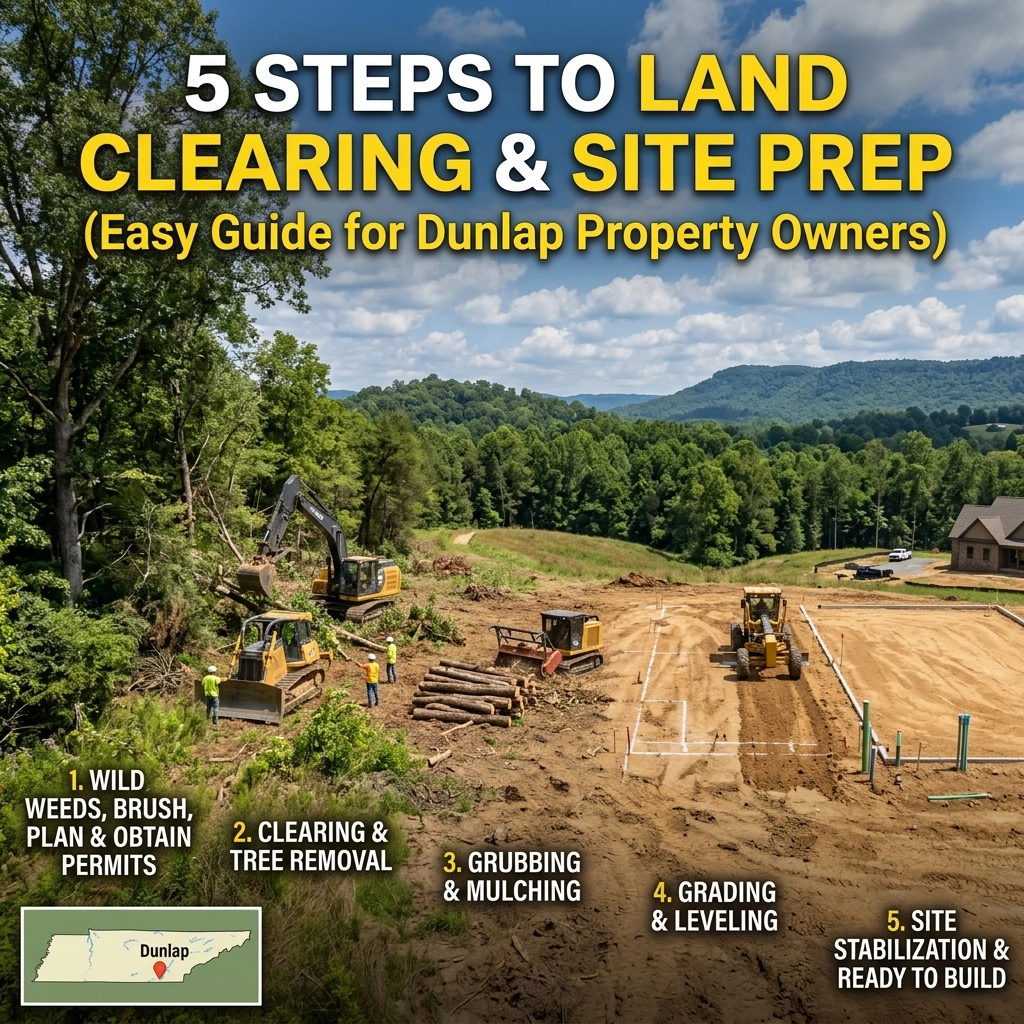
5 Steps to Land Clearing and Site Prep (Easy Guide for Dunlap Property Owners)
Starting a construction project in Dunlap or the surrounding Sequatchie Valley is a significant investment. Whether you are a homeowner planning a dream house or a contractor managing a new commercial build, the success of the entire structure depends on what happens before the first brick is laid. Proper site preparation is more than just knocking down a few trees. It is a technical process that involves understanding the soil, managing water runoff, and ensuring the ground is stable enough to support your heavy equipment and future foundation.
At Whitzell Excavation, we specialize in transforming raw Tennessee land into build-ready lots. From the rocky terrain in Pikeville to the dense brush in Jasper and Whitwell, we have seen every type of landscape our region offers. This guide outlines the essential steps to prepare your property correctly, ensuring your project starts on a solid, code-compliant foundation.
Step 1: Strategic Planning and Local Permitting
Every successful land clearing project begins long before the heavy machinery arrives on-site. We believe that a well-documented plan is the most effective way to avoid costly delays and legal hurdles. This phase involves defining the exact footprint of your build and identifying which areas of the property must remain undisturbed.
In Sequatchie County and Marion County, local regulations may dictate how you handle vegetation removal and soil disturbance. We work closely with property owners to ensure all activity aligns with local environmental standards. This includes identifying property lines and ensuring that any clearing near neighboring lots in places like Powells Crossroads or Lone Oak is done with precision.
High-Level Planning for Long-Term Success
Strategic. Informed. Ready.
► Define project goals to ensure the clearing process matches the final use of the land, whether it is for a residential foundation or agricultural pasture.
► Secure necessary permits by consulting with local building departments in Dunlap or Pikeville to stay compliant with zoning laws and environmental protections.
► Identify underground utilities before any digging starts to prevent dangerous and expensive damage to existing water, gas, or electrical lines.
► Establish a budget that accounts for both the visible clearing work and the necessary soil stabilization that follows.
Step 2: Comprehensive Land Assessment
Once the plan is in place, our team conducts a thorough walk-through of the property. This assessment is critical because the geography of Middle Valley and the surrounding ridges can vary wildly. We look for potential obstacles such as large boulders, hidden stumps, and areas of poor drainage that could compromise a foundation digging project.
Understanding the soil composition is another vital part of this step. In our area, we often encounter heavy clay or rocky soil that requires specific handling to achieve proper compaction. We also evaluate the topography to determine how water will flow across the site once the natural vegetation is removed.

Analyzing Terrain and Soil Integrity
Precise. Thorough. Comprehensive.
► Evaluate soil stability to determine if additional fill dirt or specialized compaction techniques are required for a stable building site.
► Map out drainage patterns to prevent future erosion or basement flooding, which is a common issue in the rolling hills of Sequatchie County.
► Identify protected vegetation or trees that should be preserved for aesthetics or soil retention, especially on sloped lots.
► Locate rock outcroppings that might require specialized excavating services or heavy-duty machinery to remove or navigate.
Step 3: Selecting the Right Equipment
Not all land clearing is created equal. Using the wrong machinery can lead to inefficient work or, worse, damage to the soil structure. At Whitzell Excavation, we maintain a fleet of specialized equipment designed to handle the diverse challenges of Dunlap and Marion County properties.
For dense brush and smaller trees, we utilize high-performance mulchers and skid steers. For larger-scale land clearing, we bring in excavators and bulldozers that can remove deep-rooted stumps and move massive amounts of earth quickly. Selecting the right tool for the job ensures the project remains on schedule and the land is treated with the necessary precision.

Utilizing Professional Grade Machinery
Powerful. Efficient. Specialized.
► Deploy heavy excavators for the removal of large stumps and deep-seated rocks that manual labor or smaller tools cannot budge.
► Utilize bulldozers for initial rough grading and pushing debris into manageable piles for hauling or disposal.
► Coordinate dump truck hauling to remove excess organic material and rocks from the site, keeping the workspace clean and safe.
► Implement compaction rollers once the clearing is done to ensure the ground is firm enough to support a concrete slab or gravel driveway.
Step 4: Executing the Clearing Process
The execution phase is where the physical transformation happens. We begin by removing the "overburden," which includes the trees, brush, and topsoil that are not suitable for building. It is not enough to simply cut trees down; the root systems must be completely extracted to prevent future sinkholes or foundation shifting as the organic matter decays over time.
During this stage, we also focus on debris management. We ensure that all removed material is handled according to the property owner's wishes, whether that involves dump truck hauling it away or processing it on-site. Our team works systematically across the lot in Whitwell or Pikeville, ensuring that we don't trap ourselves or the machinery in a corner of the property.
Removing Obstacles with Technical Precision
Clean. Professional. Disciplined.
► Extract all root balls to ensure the subsoil remains stable and free of organic voids that could cause future settling.
► Clear access routes early in the process so that subsequent contractors, like concrete or framing crews, can easily reach the building site.
► Manage vegetation debris by hauling it off-site to keep the property looking professional and ready for the next phase of construction.
► Protect surrounding areas from unnecessary disturbance, ensuring that the clearing stays within the designated boundaries of the project.
Step 5: Final Grading and Site Preparation
The final step is perhaps the most important for the longevity of your build. Once the land is clear, we perform final grading and site prep. This involves shaping the land to ensure water flows away from the future structure. Poor drainage solutions are the leading cause of foundation failure, and we take this step very personally.
This is also when we prepare for specific infrastructure. If your property in Jasper or Sequatchie County requires a septic system, we perform the necessary septic tank installation prep. We also handle the rough-ins for driveways and retaining wall preparation if the lot has significant elevation changes.

Ensuring Structural Integrity and Drainage
Stable. Level. Permanent.
► Execute finish grading to create a smooth, level surface that meets the exact specifications of your architectural or engineering plans.
► Install drainage systems such as French drains or culverts to manage rainwater and protect the site from erosion.
► Prepare for utilities by trenching for water lines, electrical conduits, and septic systems in a code-compliant manner.
► Compact the building pad using industry-standard methods to ensure the soil can support the weight of the foundation and the structure above it.
Why Property Owners Trust Whitzell Excavation
At Whitzell Excavation, we understand that we are not just moving dirt; we are laying the groundwork for your future. Whether you are in Tracy City, Monteagle, or South Pittsburg, our commitment to technical expertise and precision remains the same. We take pride in being the first team on the job site, setting the tone for the entire construction process.
We collaborate closely with both individual homeowners and professional contractors to ensure every project is completed on time and within budget. Our deep knowledge of local soil conditions and our high-quality equipment allow us to overcome the unique challenges of the Sequatchie Valley and surrounding areas.
When you choose us, you are choosing a partner dedicated to the longevity and stability of your project. We don't cut corners, and we don't leave a site until it is perfectly prepared for the next stage of development. If you are ready to start your next project in Dunlap, Pikeville, or anywhere in our service area, we are ready to help you clear the way.
For more information on our specific services or to view our past work, feel free to explore our gallery or reach out to us directly through our homepage. We look forward to helping you build something that lasts.

